Pena Palace History, Architecture and Fascinating Facts
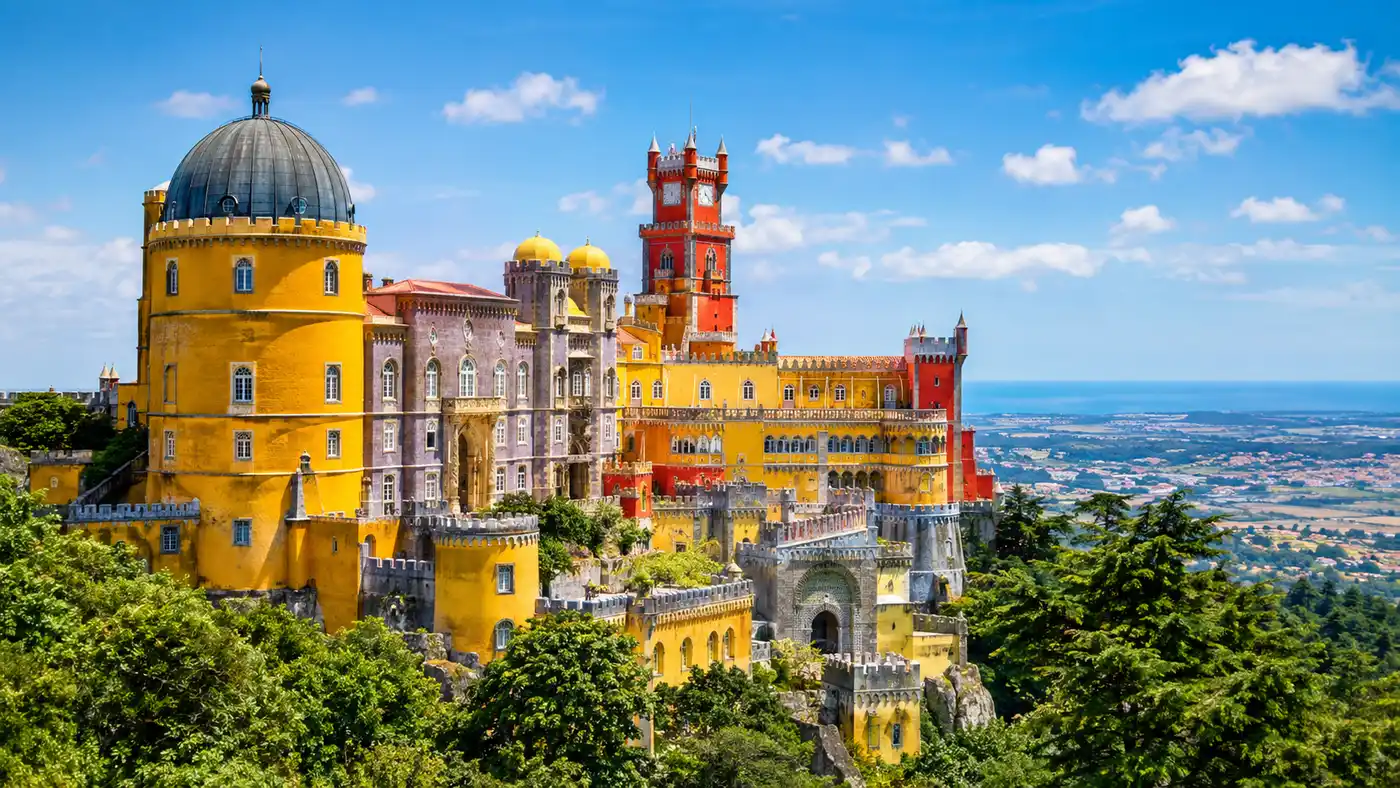
Walking through the iron gates on a damp morning in Sintra feels strange. Your first glimpse through the trees is not classical grey stonework or dignified royal marble. Instead, you see a shock of mustard yellow and brick red cutting through thick Atlantic fog. Looking into pena palace history explains why this bizarre mountain fortress looks less like an official royal residence and more like an eccentric opera set dreamed up by someone who simply refused to grow up.
Perched high on the Serra de Sintra, the palace stands directly on top of jagged granite peaks that look out over the ocean. Most visitors know it as the colorful castle in Portugal that dominates Instagram feeds. Behind the bright plaster and crowded terraces lies a five-hundred-year story of quiet devotion, catastrophic earthquakes, royal obsessions, and wild architectural rebellion. It is easily one of the most eccentric buildings in Europe.
Book your pena palace experience:
The Monastery Roots: Early History of Pena Palace
Long before any king lived here, the mountain belonged to quiet monks. The story starts in the Middle Ages when a small chapel dedicated to Our Lady of Pena was erected on the summit. Local legend claimed the Virgin Mary appeared to a shepherd on the jagged outcrop, prompting the construction of a tiny shrine where pilgrims hiked through dense pine woods to pray.
In 1503, King Manuel I visited the mountain. He stood on the granite rocks, saw the Lisbon coastline in the distance, and felt moved by the solitude. Manuel ordered the construction of a proper monastery, handing it over to the Order of Saint Jerome. Eighteen Hieronymite monks lived there in total isolation, enduring bone-chilling winters, damp sea mist, and howling winds.
Life on the peak was hard. Lightning struck the monastery tower in the early 18th century, scorching the living quarters. The real catastrophe struck on November 1, 1755. The Great Lisbon Earthquake shook southern Portugal to pieces, and the tremors pulverized the monastery walls into heaps of broken masonry. Strangely, the original 16th-century chapel, with its vaulted ceiling and delicate alabaster altarpiece carved by Nicolau de Chanterene, survived with barely a scratch. The monks fled down the mountain, and for nearly eighty years, the ruins sat abandoned. Brambles took over the cloisters, moss swallowed the stairs, and local shepherds used the hollow nave to shelter goats from sudden rainstorms.
Note: Sintra has an unpredictable microclimate. Even when Lisbon is 28 degrees and completely clear, the palace peak can be trapped inside freezing mist, so keep a light jacket in your daypack.
King Ferdinand II: Who Built the Colorful Castle?
Everything changed on a hike in 1838. Ferdinand of Saxe-Coburg and Gotha, a cultured young German prince who had married Portugal's Queen Maria II, rode up into the Sintra hills. Ferdinand was twenty-two years old, artistic, and deeply fascinated by the natural world. Staring up at the ruined monastery cloaked in ivy, he decided to buy the ruins along with the surrounding mountain slopes using his private allowance.
Ferdinand was an unusual monarch. Politics bored him, but botany, theatre, and drawing consumed his days. Locals nicknamed him the King-Artist. His original plan was modest enough: restore the ruined monastery as a breezy summer residence where the royal family could escape Lisbon's stifling heat. As work progressed, his imagination ran away with him, and the modest renovation turned into an enormous, sprawling fantasy castle.
To bring his vision to life, Ferdinand hired Baron Wilhelm Ludwig von Eschwege. Eschwege was an odd choice for chief architect because he was actually a Prussian mining engineer who had spent over twenty years managing gold mines and surveying in Brazil. He had traveled widely across Europe and North Africa, sketching Moorish battlements and Bavarian fortifications along with geological formations. Eschwege had almost no formal architectural training. That turned out to be an advantage. Unbound by traditional design rules, Eschwege and Ferdinand treated the mountain like a blank canvas, sketching onion domes, drawbridges, and Manueline carvings directly into their personal journals.
Construction began around 1842. Workers hauled granite blocks up narrow dirt tracks using teams of oxen. Ferdinand insisted on incorporating the surviving monastic ruins rather than tearing them down, which explains why the palace floor plan feels so labyrinthine. By 1854, the heavy structural work was done, though decorators, plasterers, and painters continued refining the rooms for decades.
- King Ferdinand II: The visionary royal who financed the entire project with his private fortune to build an escape from court life.
- Queen Maria II: Ferdinand's wife, who supported the costly project despite public skepticism about her husband's tastes.
- Baron von Eschwege: The German mining engineer who translated Ferdinand's theatrical daydreams into solid stone.
- Countess of Edla: Elise Hensler, an opera singer who became Ferdinand's second wife and helped shape the mountain's botanical park.
Architectural Wildness: Neo-Islamic, Gothic, and Manueline Styles
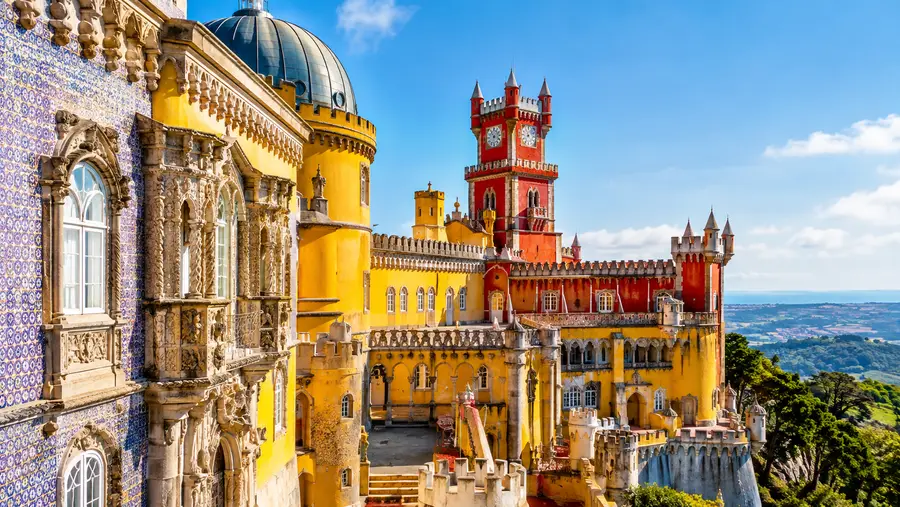
Trying to classify the architecture of Pena Palace will give any traditional historian a headache. It belongs squarely to 19th-century Romanticism, a movement that rejected tidy classical proportions in favor of emotion, exoticism, and historic revival. Ferdinand threw every style he loved into a single building. You find yourself standing between a Moorish gatehouse, a Gothic watchtower, and a Portuguese Manueline cloister without taking more than twenty steps.
The centerpiece of this stylistic madness is the Triton Gateway. Passing beneath it is an unforgettable experience. A monstrous stone creature - half-man, half-fish, scowling with coral-encrusted features - anchors the archway above you. His hair dissolves into tangled sea vines, and his arms support a heavy bay window as if holding up the entire palace structure. The figure represents an allegory of the creation of the world, bridging the elements of earth and water. It is grotesque, magnificent, and slightly terrifying.
Inside, the palace interiors reveal a fascinating contrast between royal ceremony and cozy domestic clutter. The Arab Room features delicate neo-Islamic plasterwork inspired by the Alhambra in Granada, painted with geometric patterns that took artisans months to replicate. Just down the hallway, the Queen's dressing room and the dining hall feel surprisingly lived-in, lined with ornate porcelain, French chandeliers, and heavy oak furniture.
Pro tip: While crossing the Arches Yard, look carefully at the reddish-pink towers behind the Moorish arches. That warm pink section is the actual 16th-century monastery; Ferdinand kept the monks' original footprint intact and built the yellow wing around it.
The exterior colors caused a massive scandal in the 1990s. For decades, the Atlantic salt air and relentless rain had scrubbed the palace exterior into a dull, uniform grey. People assumed the castle had always been bare stone. When the Portuguese government carried out a restoration in 1994 and repainted the walls in vivid canary yellow and terra-cotta red, locals were furious. Many thought it looked like an amusement park. Archival research and original paint chips proved that Ferdinand had deliberately chosen those exact shades so his castle would shine through the grey Sintra fog like a beacon.
Book your pena palace experience:
Milestones in Pena Palace History
The mountain peak changed hands repeatedly across five centuries, evolving from a solitary prayer retreat into a state-owned cultural treasure.
| Year / Period | Key Figure | Historical Event |
|---|---|---|
| 1503 | King Manuel I | Construction of the original Hieronymite monastery on the mountain peak. |
| 1755 | Lisbon Earthquake | Monastery destroyed by violent tremors; only the Manueline chapel survives intact. |
| 1838 | King Ferdinand II | Ferdinand purchases the abandoned monastery ruins and surrounding forest lands. |
| 1842-1854 | Baron von Eschwege | Primary construction of the Romanticist palace around the surviving chapel ruins. |
| 1885 | Countess of Edla | Ferdinand passes away, bequeathing the property to his widow before the state reacquires it. |
| 1910 | Queen Amélia | Royal family flees into exile following the revolution; the palace becomes a national museum. |
| 1995 | UNESCO | Inscribed as a World Heritage site under the Cultural Landscape of Sintra. |
Ferdinand did not stop at building stone walls. He treated the surrounding mountain as an extension of the architecture. The hills had been completely deforested by centuries of logging and fires, leaving little more than scrub brush and bare granite boulders. Ferdinand ordered over five hundred tree species to be shipped in from every corner of the Portuguese empire and beyond. He planted giant North American redwoods, Australian tree ferns, Japanese cypresses, and Chinese ginkgos.
Exploring the gardens and park reveals a landscape built to provoke wonder. Winding paths lead to hidden grottos, stone bridges spanning small streams, and five artificial duck lakes tucked into shaded ravines. Ferdinand spent his later years tending these trees himself, frequently wandering the dirt paths in worn boots with gardening shears tucked into his waistcoat pocket.
Fascinating Facts About Pena Palace You Probably Didn’t Know
Behind the grand facade are small historical details that guidebooks usually leave out. Some explain the castle's strange quirks, while others paint a picture of how the royals actually lived inside its walls.
- The Neuschwanstein cousin: Ferdinand II was a first cousin of King Ludwig II of Bavaria. Ludwig visited Sintra, fell in love with Pena's romantic silhouette, and drew inspiration from it before constructing Neuschwanstein Castle in Germany.
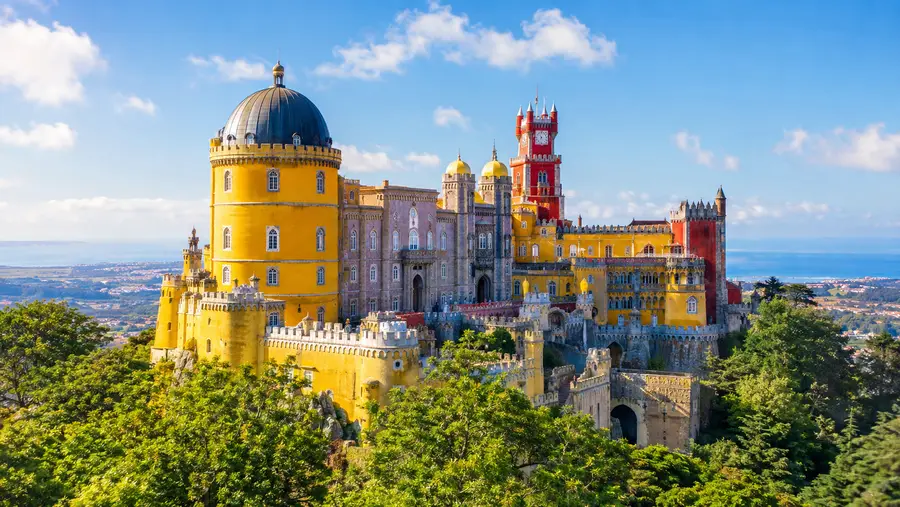
- The solitary cloud phenomenon: For centuries, Atlantic sailors used the Serra de Sintra as a navigational beacon. Due to the unusual elevation and humidity, a thick white cloud frequently forms directly over Pena Palace while the surrounding coastline remains clear.
- Queen Amélia's last night: On October 4, 1910, Queen Amélia walked the terraces of Pena alone, watching Lisbon burn during the republican uprising. She left the palace the next morning, never to return to Portugal alive.
- Frozen in time: When the royal family fled in 1910, the new republican government locked the palace doors. Inside, dining tables were left set with silver cutlery, open books stayed on reading stands, and royal toothbrushes sat beside porcelain washbasins.
- Early royal tech: Pena was one of the earliest buildings in Portugal to have indoor plumbing and an experimental telephone line connecting Sintra directly to the Necessidades Palace down in Lisbon.
Frequently Asked Questions about pena palace history
When was Pena Palace built?
Construction of the palace began in 1842 and the primary structure was finished around 1854, though decorative work and interior styling continued well into the 1880s.
Who lived in Pena Palace?
The palace was lived in by King Ferdinand II and his second wife, the Countess of Edla. Later, it served as a summer residence for King Carlos I and Queen Amélia until the Portuguese monarchy was overthrown in October 1910.
Is Pena Palace a UNESCO World Heritage site?
Yes. In 1995, UNESCO declared the entire Serra de Sintra a World Heritage site under the category of Cultural Landscape, specifically citing Pena Palace as a pioneering example of 19th-century Romantic architecture.
Why was Pena Palace painted yellow and red?
King Ferdinand II chose bright yellow and red paints to make the building visible from miles away against the dark green forest and heavy mountain mist. The colors also distinguished the older 16th-century monastery wing from the newer 19th-century palace addition.
Quick Reference
- Built between 1842 and 1854 by King Ferdinand II
- Blends Neo-Manueline, Moorish, and Gothic styles
- Survived the 1755 Lisbon earthquake as a ruined monastery
- Houses over 500 exotic tree species in its surrounding park
Book your pena palace experience:
My Take on Pena's Unapologetic Chaos
A lot of architectural critics in the early 20th century hated this place. They called it garish, tasteless, and childish. Standing on the Queen's Terrace with the sea wind blowing across your face, it is hard to care about their opinions. Ferdinand built Pena Palace not to impress visiting ambassadors or display military power, but simply because he wanted to live inside a fairytale of his own making. Take your time wandering past the Triton gateway, touch the mossy granite walls of the old cloister, and watch how the colors shift whenever the Sintra mist rolls across the towers.
Read more about pena palace.